Quality Inspector

Concrete Calculators
Screed Flooring Calculator (2026) – Precision Leveling Estimator
Expert Guide

Determine the exact volume of raw materials required to lay a professional floor screed. Handles both standard mortar for thin layers (<2") and fine concrete with chips for thicker leveling (>2").
🛠️ How It Works
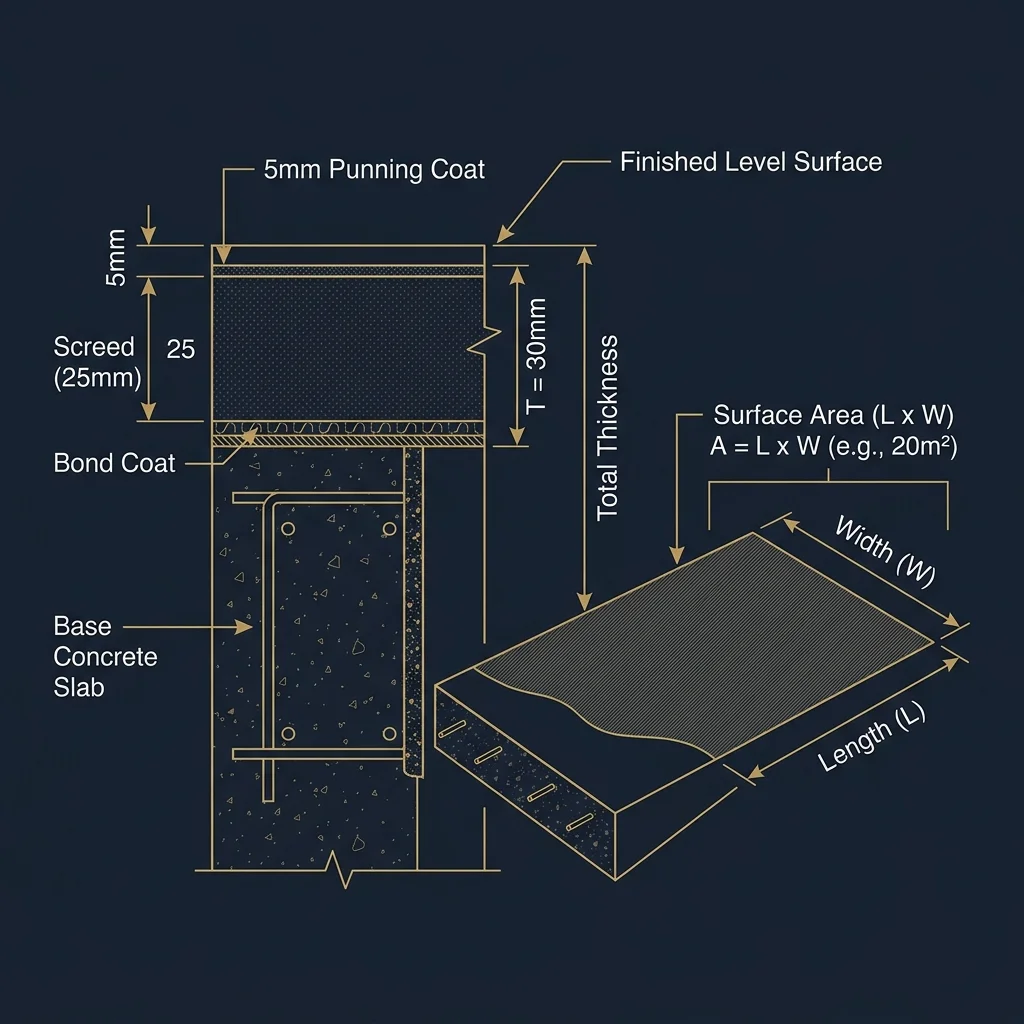
The calculator determines the wet volume by multiplying Area and Thickness. For thin layer mortar (<2"), it applies a 1.33 dry factor. For structural screed (>2") with chips, it uses a 1.54 factor to account for stone and sand density. Punning is calculated as a separate 5mm 1:1 finishing coat.
- •Measure the floor area and determine the required thickness (standard is 40-75mm).
- •Select **1:2:4** for residential standard leveling or **1:1.5:3** for industrial durability.
- •The calculator applies the **1.54 Expansion Factor** to find the total dry volume of raw materials.
- •Materials are then split into Cement (bags), Sand (CFT), and 10mm Chips (CFT).
- •If **Punning** is selected, a 5mm 1:1 cement-sand coat is added to the total estimate.
📐 Calculation Formula
Wet Volume = Area × Thickness
Dry Volume (Mortar < 2") = Wet Volume × 1.33
Dry Volume (Concrete > 2") = Wet Volume × 1.54
Punning Coat = (Area × 0.0075m) × 1.33 (optional)
⚠️ Common Mistakes to Avoid
- ✕Using the 1.33 mortar factor for chips screeding, which leads to a severe shortage of materials.
- ✕Forgetting to properly clean and wet the base slab, causing the screed to "hollow" or peel.
- ✕Applying a punning coat that is too thick (>10mm), which often leads to hairline cracks (crazing).
- ✕Skipping the 7-day water curing period, which reduces the surface hardness of the finished floor.
🔍People Also Search / यो Calculator मा अक्सर खोजिने कुराहरू
Floor screeding cement sand ratio Nepal 2026
How to calculate punning materials 1:1
Self-leveling vs traditional screed material count
Floor leveling price per sq ft Nepal cost
Wait time after screeding for tiles installation
Bhui chillo banaune tarika ra punning
Farsh ke liye cement balu ka estimate
1:2:4 screed calculation for home flooring
Punning coat thickness and material budget
फर्श के लिए सीमेंट बालू का एस्टिमेट कैसे करें?
❓ Frequently Asked Questions
Punning is a 5-10mm thin layer of rich cement-sand (1:1) mortar applied over the leveled screed for a smooth, dust-free finish.
For a 100m² floor at 50mm using 1:2:4 ratio, you need approx 32 bags of cement. This tool helps you define the exact ratio for precise ordering.
Chips (fine concrete) provide better structural bonding and prevent long-term hollow sounds in the floor compared to pure sand-mortar.
Stop Guessing.
Start Building.
- ✕Square Feetको भ्रममा नफस्नुहोस्।(Don't get trapped in "Square Feet" rate illusions.)
- ✓Save up to 11% on materials with an accurate BOQ.
Worth NRs. 5,000
NRs. 999 🎯
Get Expert EstimateLimited Time Launch Price