Quality Inspector

Tiles & Flooring
Tiles Calculator (2026) – Floor, Wall, Skirting & Grout Estimator
Expert Guide

Estimate floor & wall tiles, skirting length, and grout kg with adjustable wastage.
⚡ Quick Answer
For a 20m² floor with 600x600mm tiles (4 per box), you need approximately 62 tiles (56 net + 10% wastage) = 16 boxes. For premium tile BOQs, visit pro.nirmansutra.com.
🛠️ How It Works
- •Level the surface (Floor/Wall) and enter the total area.
- •Select your tile size and the number of tiles per box provided by the manufacturer.
- •Switch to "Skirting" mode to calculate exact running length minus doors.
- •Use "Grout" mode periodically to find the filler requirements for your specific joint width.
📐 Calculation Formula
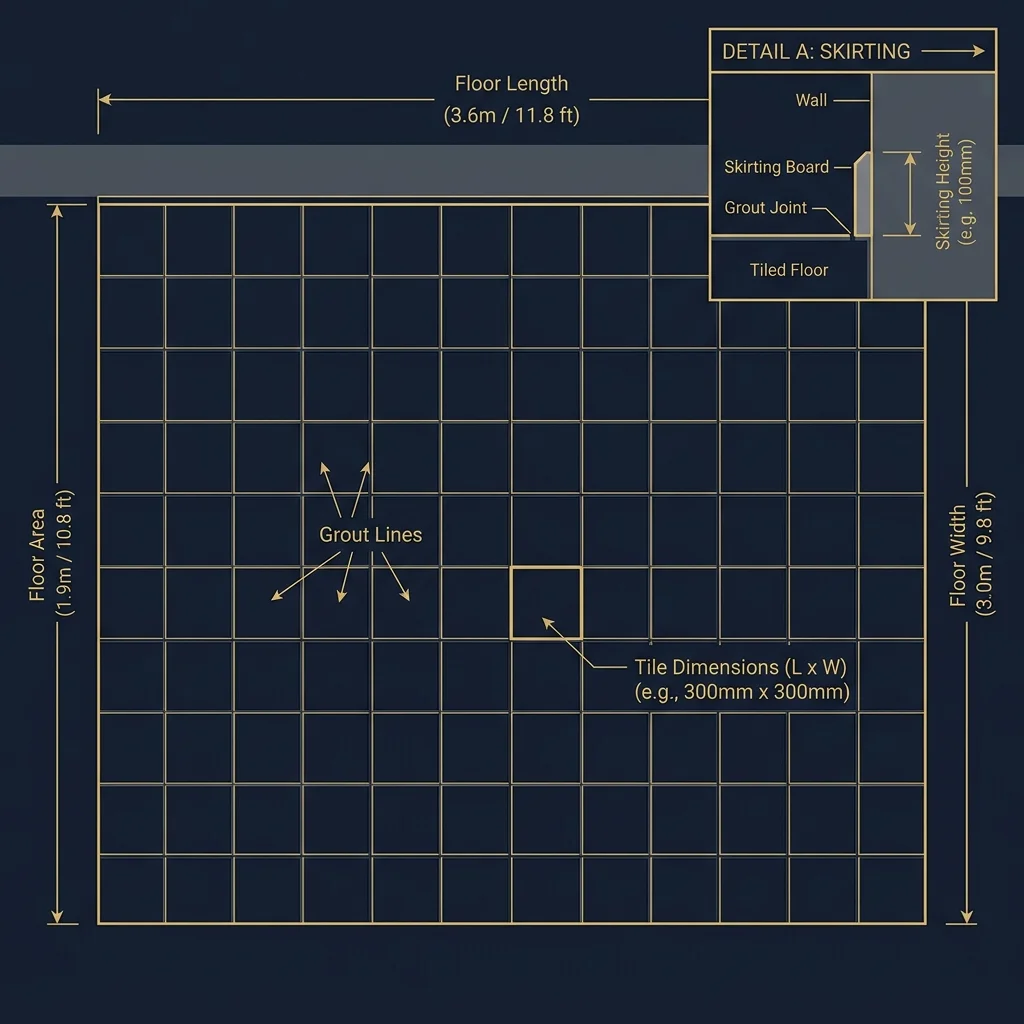
Number of Tiles = (Surface Area / Individual Tile Area) + Wastage
Total Boxes = Number of Tiles / Tiles per Box
Grout (kg) = Area × [ (L+W) / (L×W) ] × Joint Width × joint Depth × 1.5
📋 Real-Life Example
Example: Tiling a 20m² room with 600x600mm tiles (4 tiles/box, 10% waste).
1. Net Tiles = 20 / 0.36 = 55.6 -> 56 tiles.
2. With 10% Waste = 56 * 1.10 = 62 tiles.
3. Boxes = 62 / 4 = 15.5 -> Order 16 boxes.
⚠️ Common Mistakes to Avoid
- ✕Using 10% wastage for diagonal layouts — diagonal patterns require 15-20% extra due to corner cuts.
- ✕Forgetting to deduct door widths when calculating skirting — this results in buying too much stone/tile.
- ✕Not factoring in tile thickness for grout — thicker tiles (e.g., stone) require much more grout volume.
🔍People Also Search / यो Calculator मा अक्सर खोजिने कुराहरू
Tiles per sq ft calculator Nepal price 2026
600x600 tile boxes for 100 sq ft calculation
Bathroom wall and floor tiles estimator
Tile adhesive vs cement mortar for flooring
Best tiles brands in Nepal with price list
Tile ra cement ko hisab nikalne tarika
Kitchen backsplash tile area calculator
Tiles price in Kathmandu per square foot
Marbonite vs Ceramic tiles cost calculation
टायल र सिमेन्टको हिसाब निकाल्ने तरिका
❓ Frequently Asked Questions
Standard 600x600 mm (2x2 ft) vitrified tiles usually come with 4 pieces per box, covering 1.44 square meters (approx 15.5 sq.ft).
For a straight layout, add 10% wastage. For diagonal or complex patterns, add 15-20% to account for corner cuts and breakage.
For standard tiles with a 3mm joint, you need approximately 0.5kg to 0.8kg of grout per square meter.
Stop Guessing.
Start Building.
- ✕Square Feetको भ्रममा नफस्नुहोस्।(Don't get trapped in "Square Feet" rate illusions.)
- ✓Save up to 11% on materials with an accurate BOQ.
Worth NRs. 5,000
NRs. 999 🎯
Get Expert EstimateLimited Time Launch Price