Quality Inspector

Masonry & Wall
Brick Wall Estimator (Masonry)
Expert Guide

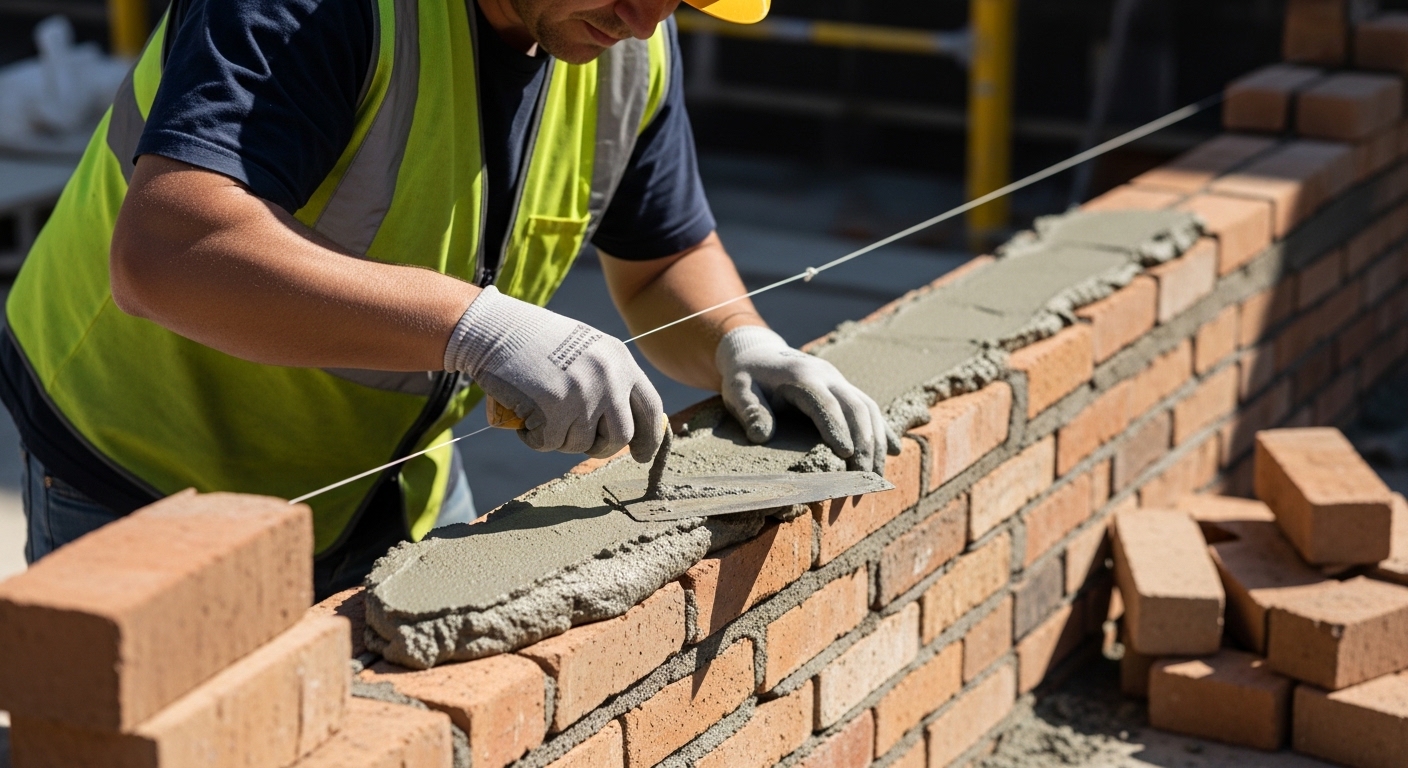
Calculate the total number of bricks, bags of cement, and sand required for a wall of given dimensions.
⚡ Quick Answer
For a standard 9-inch brick wall in Nepal, this tool automatically deducts 3" Sill and 4" Lintel heights from your provided wall height to give a precise net estimate. For a 5m × 3m wall (9-inch thick), you need approx 1,734 Nepal bricks or 1,600 India bricks after deductions.
🛠️ How It Works
First, we find Net Height = Total Height - (Sill + Lintel). Then, Wall Volume = Length × Net Height × Thickness. We divide this by the brick volume including a 10mm mortar joint.
- Enter your total wall length and floor-to-floor height.
- The tool automatically deducts 7 inches (178mm) for the standard Sill and Lintel heights.
- Select the wall thickness (9" or 4.5") and your specific brick size.
- Choose the mortar ratio (1:4 or 1:6).
- Hit Calculate to get net bricks, cement, and sand counts.
📐 Calculation Formula
Net Height = Total Height − 0.1778m (7")
Wall Volume = Length × Net Height × Thickness
Brick Volume (with mortar) = (L + 10mm) × (W + 10mm) × (H + 10mm)
Total Bricks = Wall Volume ÷ Brick Volume
📋 Real-Life Example
For a 5 m long × 3 m high wall (9-inch / 230 mm thick):
• Net Masonry Height = 3.0 − 0.1778 ≈ 2.822 m
• Net Wall Volume = 5.0 × 2.822 × 0.23 ≈ 3.245 m³
• Using Nepal Bricks (230 × 110 × 55 mm) with 10 mm mortar joint:
• Brick with mortar = 0.240 × 0.120 × 0.065 = 0.001872 m³
• Total Bricks = 3.245 ÷ 0.001872 ≈ 1,734 bricks
• Cement (1:6) ≈ 5 bags
• Sand ≈ 33.5 CFT
⚠️ Common Mistakes to Avoid
- Forgetting that the tool already deducts Sill and Lintel. Do not double-deduct these heights if you enter a net height.
- Forgetting to deduct large area for doors and windows. Use → Deduction Calculator
- Not adding a 5–10% wastage buffer for site breakage.
- Using the wrong brick dimensions for local stocks.
❓ Frequently Asked Questions
In standard Nepal construction, a wall has a Sill level (3") and a Lintel level (4") which are made of concrete, not bricks. This tool automatically deducts these to ensure you don't over-order bricks and mortar.
For a 4.5-inch wall: approx 55–60 bricks per m². For a 9-inch wall: approx 110–120 bricks per m².
The standard Nepal brick is 230 × 110 × 55 mm (9″ × 4.3″ × 2.2″).
With a 1:6 mortar ratio, you need approximately 2–3 bags (50 kg each) of cement for every 1,000 bricks laid in a 9-inch wall.
1:6 (cement:sand) is the standard mix for most partition and non-load-bearing walls. Use 1:4 (rich mix) for load-bearing walls, underground structures, and wet areas.
1 m³ = 35.3147 CFT. If you need 500 bricks per m³, that is approximately 14.2 bricks per CFT.
Yes. Always add 5–10% extra for breakage during transport, handling, and cutting. On sites with complex geometry or many openings, add up to 15%.
Brick masonry should be kept wet (cured) for at least 7 to 10 days. Proper curing prevents the mortar from drying out too quickly, ensuring it reaches its maximum strength and minimizing cracks.
Stop Guessing. Start Building.
- ✕Square Feetको भ्रममा नफस्नुहोस्।(Don't get trapped in Square Feet rate illusions.)
- ✓Save up to 11% on materials with an accurate BOQ.
- 🎯Worth
NRs. 5000, Now for NRs. 999 only!